

Table of Contents
- Step 1: Verify the Website's Legitimacy and Security
- Step 2: How to Spot Fake Clothing Websites
- Step 3: Evaluate Fabric Quality and Print Durability
- Step 4: Review Sizing Guides and Fit Recommendations
- Step 5: Understand Return Policies and Guarantees
- Step 6: Choose Ethical Christian Clothing Brands 2026
- Step 7: Use Secure Payment Methods and Protect Your Data
- Conclusion
Last Updated: August 20, 2026
Step 1: Verify the Website's Legitimacy and Security
When buying faith-based clothing online, verify the website is trustworthy first. Fake or poorly maintained sites can steal payment information, deliver counterfeits, or disappear after taking your money.
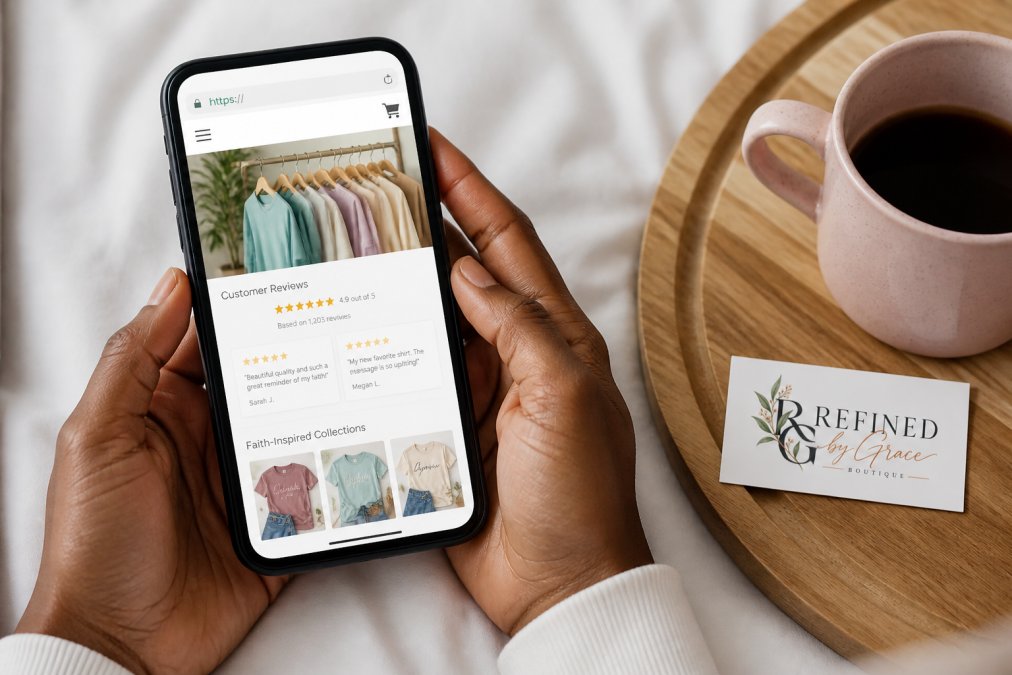
Check for SSL encryption and secure checkout
Look for the padlock icon next to the URL in your browser's address bar and confirm the URL starts with "https://" (not "http://"). This indicates SSL encryption protecting your data during transmission.
Examine the checkout process. Legitimate faith-based apparel retailers use established payment processors like Stripe, PayPal, or Square. You should be redirected to a secure, recognizable payment gateway, never enter credit card details directly on the website. Wire transfers, cryptocurrency, or untraceable payment methods are major red flags.
Check for trust badges from organizations like the Better Business Bureau, Norton Secured, or McAfee Secure. Real boutiques like Refined By Grace Boutique prioritize payment security and transparency about data handling.
Research the brand's background and physical address
Legitimate faith-based apparel brands display clear contact information: physical mailing address, phone number, and email. Fake sites list only generic emails or nothing at all.
Visit the "About Us" page. Refined By Grace Boutique, for example, clearly explains its focus on helping women express their faith boldly through colorful, confidence-boosting apparel. Detailed, authentic brand stories indicate legitimacy.
Search the brand name plus "reviews" on Google. Real brands have consistent presence across multiple platforms, Instagram, Facebook, TikTok, with regular posts and customer engagement. Brands existing on only one platform or with no social media are suspicious.
Verify the domain name is spelled correctly. Scammers use URLs slightly off from the real brand name. Type the exact brand name into your browser to confirm you're on the right site.
Step 2: How to Spot Fake Clothing Websites
Fake clothing websites have become sophisticated, but they still leave clues.
Red flags in design, pricing, and contact information
Poorly designed websites are often the first sign something's wrong. Real boutiques invest in professional design. Outdated sites, broken links, images that don't load, or spelling and grammar errors are red flags.
Pricing that seems too good to be true usually is. Christian apparel selling for $5 or with 80% off everything is suspicious. Legitimate boutiques maintain consistent pricing because they invest in quality materials and ethical manufacturing.
Check the contact page carefully. Real businesses provide multiple contact methods: email, phone, contact form, and physical address. Try sending a question and see if you get a response within 24-48 hours. Many fake sites have forms that go nowhere.
Look at the return policy. Legitimate retailers explain how long you have to return items, whether returns are free, and refund timelines. Vague or intentionally difficult policies are warning signs.
Verify customer reviews and social proof
Check where reviews are hosted. Third-party sites like Trustpilot or Google Reviews carry more weight than website-only reviews because they can't be easily faked.
Read reviews carefully. Fake reviews use generic language ("Great product!") without specific details. Real customers describe actual experiences: fit, print quality after washing, color accuracy, shipping speed.
Look for review consistency. A mix of four and five-star reviews with constructive criticism feels authentic. All five-star reviews with no negative feedback is suspicious. Pay attention to how the brand responds to negative reviews, real companies address concerns professionally.
Check review dates. Legitimate businesses get reviews spread across time. A sudden spike in reviews from the same period could indicate bulk fake reviews. Real reviewers on third-party sites have other reviews, profile pictures, and history.
Step 3: Evaluate Fabric Quality and Print Durability
Once you've verified the website is legitimate, assess whether products are worth your money. Quality matters because faith-message apparel should hold up through regular washing and wearing.
Screen-printed vs. direct-to-garment apparel
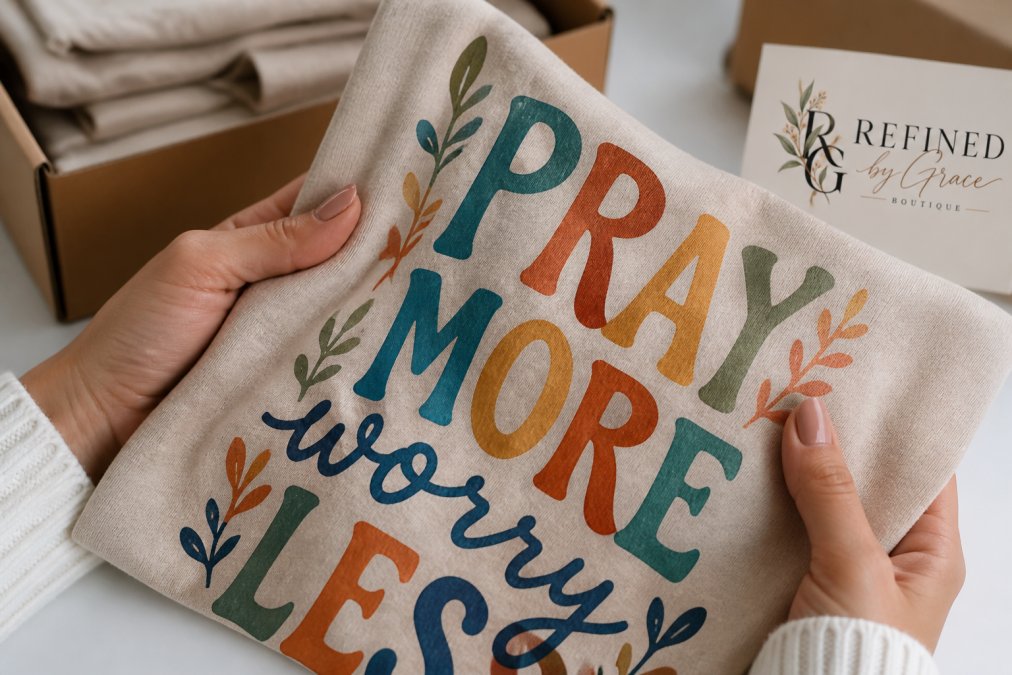
Screen-printed designs are most common for faith-based apparel. The design is pressed onto fabric using a separate screen. Quality screen printing is durable through many washes, but lower-quality versions crack, peel, or fade quickly.
Direct-to-garment (DTG) printing applies ink directly to fabric like an inkjet printer. DTG prints feel softer and can include photographic details, but may fade faster than high-quality screen printing without proper care.
Read product descriptions carefully. Legitimate brands specify their printing method and explain why. Refined By Grace Boutique prioritizes quality apparel reflecting their commitment to helping women feel confident. Descriptions should mention fabric blend, weight, and care instructions.
What to look for in product descriptions and care instructions
Fabric composition matters significantly. Look for material blend: 100% cotton, cotton-polyester blend, or other materials. Cotton is breathable but can shrink. Polyester blends are more durable and resist shrinking.
Check fabric weight, usually measured in ounces per square yard. Heavier fabric (6 ounces or more) generally means better quality and longer durability. Quality brands specify this.
Read care instructions thoroughly. Detailed guidance like "wash in cold water, tumble dry low" indicates the brand has tested the product. Vague instructions suggest less quality control.
Look for shrinkage information. Real brands acknowledge whether products shrink and by how much. Many faith-based apparel items are pre-shrunk, and legitimate brands mention it.
Check for close-up photos of design and fabric. You should see print quality, color vibrancy, and texture. Small, blurry, or heavily filtered photos prevent accurate quality assessment. Real boutiques provide multiple high-quality images from different angles.
Step 4: Review Sizing Guides and Fit Recommendations
Buying clothes online carries sizing risk since you can't try them on first. This is especially important for niche faith-based brands, which may have different sizing standards than mainstream retailers.
Compare the brand's size chart to your actual measurements. Don't assume you're a medium based on other retailers. Measure your chest, waist, and length, then compare to the brand's specific chart. Different brands cut differently.
Read customer reviews specifically for fit feedback. Look for comments like "runs small" or "generous sizing." Real customers mention whether they sized up or down. Multiple fit-issue mentions are important information.
Check whether the brand offers free returns or exchanges for sizing issues. Difficult return policies make sizing mistakes expensive. Legitimate faith-based apparel retailers understand fit is crucial and make exchanges easy.
Look for fit descriptions in product details. Does the brand describe whether a style is fitted, relaxed, oversized, or true-to-size? Some faith-based apparel is intentionally modest and loose-fitting; others are form-fitting. Clarity helps you choose correctly.
Consider whether the style works for your lifestyle. Hands-on professions need durable apparel. Everyday errands and church need versatile, put-together pieces. Reviews from people with similar lifestyles help determine fit.
Step 5: Understand Return Policies and Guarantees
Before you buy, understand what happens if something goes wrong. A clear return policy signals a legitimate, customer-confident brand.
Look for these elements: how many days you have to return items (typically 30-60 days), whether return shipping is free, how long refunds take, and whether you can exchange for different sizes or colors.
Customer-friendly policies include free return shipping and 60-day return windows, giving you time to wash and wear items to assess quality. Refunds within 5-10 business days after return receipt is standard.
Check whether the brand offers quality guarantees. Some faith-based apparel retailers guarantee prints won't crack or fade for a certain period. Others offer satisfaction guarantees for any reason. These signal confidence in product quality.
Read the fine print. Some policies restrict returns to unworn, unwashed items with attached tags, or exclude certain items. Understand these limitations before buying. Unreasonable restrictions suggest the brand lacks confidence in their products.
Step 6: Choose Ethical Christian Clothing Brands 2026
Finding ethical Christian clothing brands requires research, but it's worth the effort. Ethical brands align with faith values in design and operations.
What makes a brand ethical and transparent
Ethical Christian clothing brands are transparent about supply chains. They explain where products are manufactured, whether workers are paid fairly, and what environmental practices they follow. This transparency reflects values many faith-centered women want to support.
Look for brands prioritizing sustainable practices: organic cotton, waste minimization, or partnerships with manufacturers having strong labor practices. Brands don't need to be perfect but should be honest about impact and committed to improvement.
Check whether the brand gives back to charitable causes. Many faith-based apparel retailers donate profits to Christian organizations, missions, or community causes. This aligns with women in ministry or those wanting purchases to support their faith community.
Evaluate brand messaging. Does apparel feature uplifting, encouraging messages reflecting genuine faith values, or does it feel commercialized? Refined By Grace Boutique focuses on helping women express their faith boldly through colorful, confidence-boosting designs. Messaging reflects what the brand truly values.
Questions to ask before buying
Does this brand's mission align with your values? Do designs feel authentic and meaningful, or like religious phrases on generic apparel? Will you actually wear these pieces?
Research customer service. Reach out with a question before buying. How quickly do they respond? Are they helpful and friendly? Customer service reflects how much a brand values customers. Real boutiques treat customers like community members.
Ask whether the brand has a community or loyalty program. Some faith-based apparel retailers build community through social media groups, newsletters, or rewards programs, suggesting investment in long-term relationships.
Consider variety. Can you find pieces for different occasions and seasons? Do they offer children's clothing or accessories? Well-curated brands show thought and intentionality.
Step 7: Use Secure Payment Methods and Protect Your Data
The final step in buying faith-based clothing online safely is protecting yourself during the transaction.
Use a credit card rather than a debit card when possible. Credit cards offer more fraud protection. If something goes wrong, you can dispute the charge. Debit card fraud is harder to recover from.
Avoid wire transfers, cryptocurrency, or gift cards. These offer no protection if something goes wrong. Legitimate faith-based apparel retailers accept standard payment methods: credit cards, PayPal, and Apple Pay.
Create unique passwords for each shopping account. Don't reuse passwords across sites. Use a password manager to track complex passwords.
Never shop on public WiFi networks. Public WiFi is less secure. Use your phone's data connection or a secure home network for payment information.
Check credit card and bank statements regularly after purchasing. Look for unauthorized charges. Most fraudulent charges appear within days, but some take weeks. Contact your bank immediately if you spot something suspicious.
Enable two-factor authentication where available. This requires a code from your phone or email in addition to your password.
Consider using a virtual credit card number if your bank offers it. Some banks generate temporary card numbers for online purchases, protecting your actual card information.
When you're ready to shop for faith-based apparel reflecting your values and lifestyle, follow these seven steps. The effort you invest in verification, quality assessment, and secure payment protects both your wallet and peace of mind. Refined By Grace Boutique makes this easier with transparent sizing guides, detailed product descriptions, customer reviews, and straightforward return policies. Shop confidently knowing you've taken the right precautions.
| Step | Key Action | Why It Matters |
|---|---|---|
| 1 | Verify website security and brand legitimacy | Protects your payment information and ensures the company is real |
| 2 | Spot fake websites through design, pricing, and reviews | Prevents fraud and counterfeit products |
| 3 | Evaluate fabric quality and print durability | Ensures your apparel lasts through regular wear and washing |
| 4 | Review sizing guides and fit recommendations | Reduces the risk of ordering the wrong size |
| 5 | Understand return policies and guarantees | Protects you if something goes wrong with your order |
| 6 | Choose ethical Christian clothing brands | Aligns your purchases with your faith values |
| 7 | Use secure payment methods | Protects your financial information |
Frequently Asked Questions
How can I verify if a faith-based clothing website is legitimate?
Check for an SSL certificate (look for the padlock icon in your browser's address bar), verify the brand has a physical address and contact information, read customer reviews on independent platforms, and search the brand name with 'reviews' or 'scam' to see what others say. Legitimate faith-based clothing brands display their mission clearly, show real customer testimonials, and maintain active social media accounts with genuine engagement. Visit the company's website directly rather than clicking links from emails or social media ads.
What are the signs of a secure online clothing store?
Secure stores use HTTPS encryption (not just HTTP), display trust badges or security seals, offer multiple secure payment options, have clear return and refund policies, and provide customer service contact information. They also show real product photos, detailed size guides, and honest product descriptions. Avoid stores with only one payment method, unclear shipping policies, or generic product images. Check whether the site has been verified by payment processors like Stripe or PayPal, which indicate they've passed security checks.
Why should I choose ethical Christian clothing brands 2026 over mainstream retailers?
Ethical Christian clothing brands prioritize transparency about manufacturing, fair labor practices, and sustainable materials. Many faith-based boutiques are family-owned or mission-driven, with profits supporting charitable causes or gospel resources. These brands often use higher-quality fabrics and intentional design that reflects their values, creating apparel that lasts longer and feels more meaningful. They also build community-vetted trust through direct customer relationships and authentic testimonials, rather than mass-market marketing.
What should I do if my faith-based clothing order arrives damaged or doesn't fit?
Review the brand's return guarantee before purchasing, most reputable boutiques offer 30-60 day returns. Document the issue immediately with photos, contact customer service with your order number, and follow their return instructions. Keep packaging and shipping labels. Legitimate faith-based retailers prioritize customer trust and will work with you on exchanges or refunds. If a brand refuses to address legitimate concerns, report the experience on review platforms and consider disputing the charge with your credit card company if necessary.
This article was written using GrandRanker
